
Camping Water Filter vs Purification Tablets
Both sit in the camping top ten and they do not do the same job. A filter does not touch a virus; tablets do nothing about silt. Which you need, and when.
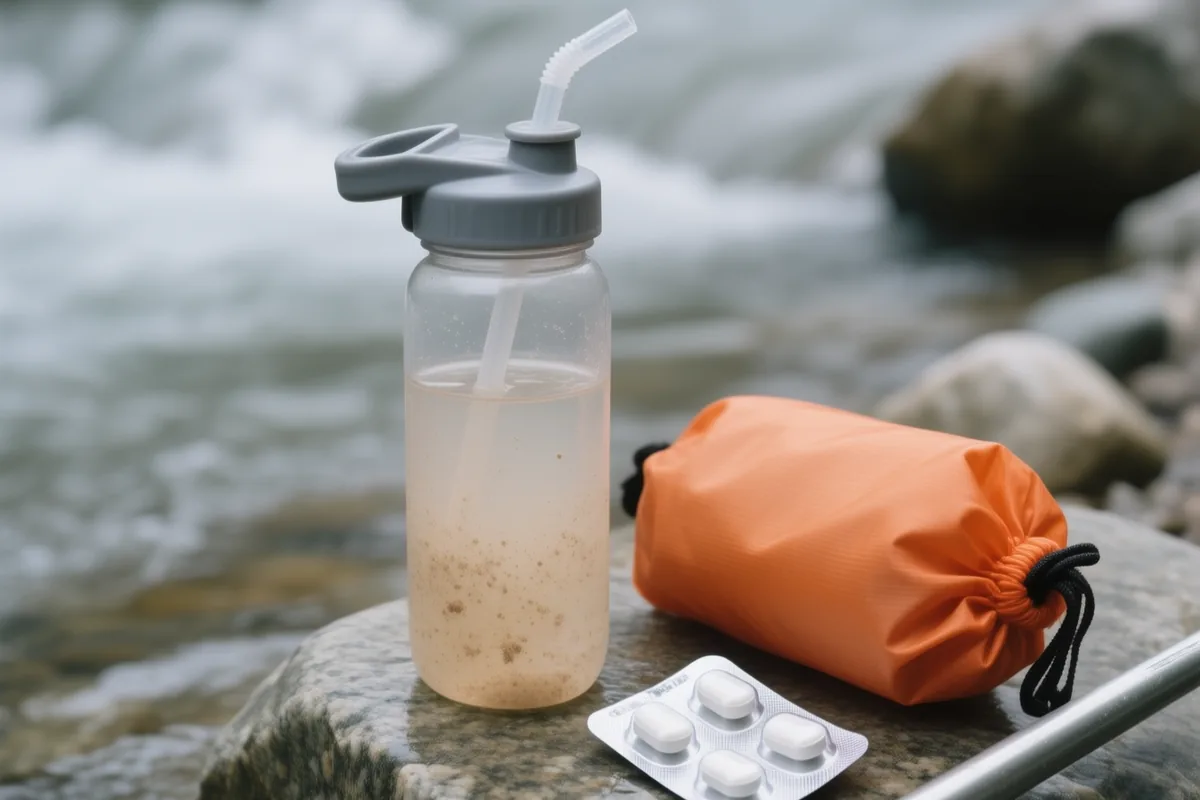
Skaði came down from the mountains to Asgard to collect a debt, and what she got was a husband whose house she could not sleep in. The gulls kept her awake. She went home.
The story is usually told as a joke about an incompatible marriage. It is also a straightforward account of somebody discovering that the conditions somewhere else are not the conditions they prepared for.
Water is the version of that which puts people in hospital.
Two products, side by side, doing different jobs
Amazon’s Camping and Hiking Equipment chart, read this morning, has water treatment at numbers five and six — purification tablets and a personal filter, sitting next to each other near the top of a chart otherwise full of insect repellent.
They are routinely discussed as alternatives. They are not alternatives. They fail at different things.
| Filter | Tablets | |
|---|---|---|
| Bacteria | Yes | Yes |
| Protozoa (giardia, crypto) | Yes | Giardia yes; crypto unreliable |
| Viruses | No | Yes |
| Silt and cloudiness | Yes | No |
| Time to drink | None | 30 minutes or more |
| Survives freezing | No | Yes |
| Weight | Some | Almost none |
Read that table and the answer stops being “which is better” and becomes “what is in the water.”
What is actually in the water decides it
Backcountry North America — animals upstream, no people. The realistic risks are protozoa and bacteria. A filter handles both, instantly, and takes out the silt as well. This is the common case, it is what the filter at number six is built for, and it is why that product has a hundred and twenty-five thousand ratings.
Anywhere with people or livestock upstream, or abroad. Now viruses are on the table — hepatitis A, norovirus, rotavirus — and a hollow-fibre filter’s pores are simply larger than a virus. Tablets handle it. So does boiling.
Cloudy or silty water. Tablets alone are the wrong answer twice over: chlorine is consumed by organic matter so the dose is unreliable, and you are drinking the silt. Filter first, then treat if the risk warrants it.
Winter, or anywhere it freezes. A filter left in a car overnight in December may be ruined and will not tell you. Tablets do not care.
The honest answer for most people is both, because they weigh almost nothing together: a filter for daily drinking and a strip of tablets in the lid of the pack for the day the filter clogs, freezes or gets dropped in the dirt.
Where these picks came from, honestly
Both read off Amazon’s own Camping and Hiking Equipment chart this morning — node 3400371 — rank, rating and review count together, best-sellers first. Both are research picks. They are the only two water-treatment products anywhere in that top twenty, which is why this piece has two picks and not four. The capability table is drawn from the standard public-health guidance on filtration versus chemical disinfection, not from testing we did; the practical advice about freezing and about treating water before rather than after a long drive is desert and mountain camping experience.
Nothing here is medical advice, and none of it applies to water you suspect of chemical contamination — mine runoff, agricultural drainage, anything with a smell. Neither of these products is for that. Carry water in instead.
The one honest warning
A filter does not remove viruses, and almost nobody selling one says this loudly.
It is not a defect and it is not dishonesty — it is physics. Hollow-fibre membranes stop things down to roughly 0.1 to 0.2 microns, which comfortably catches bacteria and protozoa. Viruses are an order of magnitude smaller and pass straight through. In the North American backcountry that is usually an acceptable risk, because viral contamination generally comes from human sewage and there is not much of it in a mountain stream.
The moment that assumption breaks — a trail with heavy traffic and poor sanitation, a campsite downstream of a village, anywhere outside the country — a filter alone is the wrong tool and it will feel exactly as reassuring as it did the day before.
The reverse warning matters too: standard chlorine tablets are not reliable against cryptosporidium. Crypto has a tough shell and needs either a filter, or chlorine dioxide specifically, or a much longer contact time than the packet suggests.
So the two products on this chart each have a hole, and the holes are in different places. That is the entire reason to understand them rather than pick one.
The picks
LifeStraw personal water filter
Number six on Amazon's camping chart this morning and the most-reviewed product on it: 4.8 stars across a hundred and twenty-five thousand ratings. A hollow-fibre membrane with pores small enough to physically stop bacteria and protozoa — the giardia and cryptosporidium that ruin a trip. It is mechanical, it needs no waiting, and the water is drinkable the moment it comes through.
- Best for
- Streams and lakes in North America, day hikes, the car emergency kit, and anyone who wants clean water now rather than in half an hour.
- Watch out
- **A filter does not remove viruses** — see the warning at the end. It also has to stay wet-then-dried properly between trips and it must not freeze; a frozen membrane can crack invisibly and a cracked filter looks exactly like a working one.
Aquatabs water purification tablets, 100 pack
Number five, 4.7 stars across three thousand three hundred ratings. Chemical treatment rather than mechanical: each tablet releases chlorine that kills bacteria, viruses and most protozoa given time. They weigh essentially nothing, a hundred of them fit in a pocket, they never clog and they do not care about being frozen or dropped.
- Best for
- Travel abroad, large volumes, a backup to a filter, and anywhere the water risk includes people upstream rather than only animals.
- Watch out
- Time and temperature matter — thirty minutes is the usual figure and cold or cloudy water wants longer. They do nothing about silt, taste or chemicals, and standard chlorine tablets are **not reliable against cryptosporidium**, which is the one thing a filter is best at. The taste is noticeable.
We do not list prices; they change daily. The button opens the current Amazon page.