
PLA or PETG: What the Filament Chart Says
Sixteen of the top twenty filaments are PLA and only two are PETG. But the most-reviewed PETG is within three hundred ratings of the most-reviewed PLA.
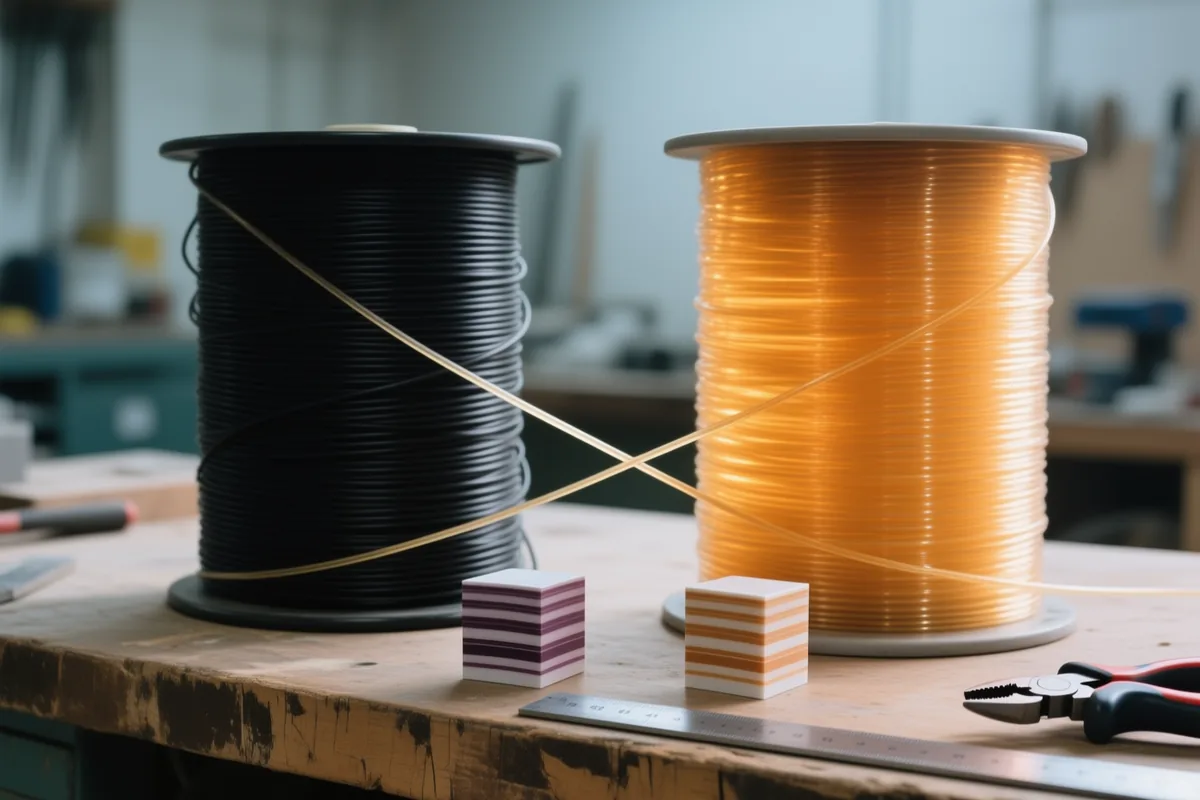
Two chains were made to hold Fenrir. Leyding was strong and he broke it. Dromi was twice as strong and he broke that too. What finally held him was Gleipnir — a ribbon, soft as silk, that the dwarves spun out of six impossible things. The gods had been solving the wrong problem twice with more of the same material.
Sixteen PLA, two PETG
Amazon’s additive manufacturing chart is ranked by units sold. The top twenty, by material:
- PLA, in its various forms — sixteen places, including all of the top four
- PETG — two places, at five and sixteen
- Two non-filament items: a refill spool and a 3D pen
On the face of it that is settled. PLA outsells PETG eight to one and owns the entire top of the chart.
Then you look at the review counts, and the picture changes.
The number that complicates it
The most-reviewed filament on the whole chart is a PLA+ at 16,999 ratings, sitting at number thirteen.
The most-reviewed PETG is at number sixteen with 16,705 ratings.
That is a gap of under three hundred ratings between the most-reviewed spool of each material — while PLA holds eight times as many chart places. Whatever is separating these two materials, it is not how much the people who use them use them. It is how many people start there.
That makes sense once you say it plainly. Every printer ships with a PLA sample. Every beginner’s guide starts with PLA. PETG is a thing people move to, usually because a PLA print failed in a specific way, and once they move they tend not to move back for that class of part.
How to actually choose
Forget the chart and ask one question: where does the part live?
- Indoors, decorative, on a shelf — PLA. It prints better, sands better, comes in more colours and costs less. There is no argument for anything else.
- Outdoors, in a car, near a window, near heat — PETG. PLA’s glass transition is low enough that a summer dashboard or a sunlit windowsill will deform it, and no amount of infill fixes a material limit.
- Load-bearing, or something that will flex without snapping — PETG. PLA is stiff and brittle; it fails suddenly. PETG bends first.
- Food-adjacent or wet — PETG, with the honest caveat that layer lines harbour bacteria regardless of material, so no printed part is truly food-safe without a liner.
Nearly every real filament argument dissolves once someone answers where the part lives.
Where these picks came from, honestly
Ranks, ratings and review counts read straight off Amazon’s additive manufacturing chart this morning — which, worth noting, is not filed under arts and crafts at all but under industrial supplies, which is why so few craft guides ever cite it. Chart node 6066126011.
This one is partly lived. There is a printer in this house and it has run both materials; the stringing, the build-plate adhesion and the PLA-in-a-hot-car failure are all things we have actually met. The specific spools above are chart reads, chosen after checking that our two existing 3D printing articles had not already used them.
The one honest warning
Do not switch to PETG to fix a print that PLA failed at for the wrong reason.
The genuine reasons to switch are heat, sunlight, moisture and flex. Those are material problems and PETG solves them.
What people actually do is get a warped corner, a poor first layer or a weak part, blame the material and buy PETG — which then strings, oozes and lifts off the plate, because PETG is less forgiving of a badly tuned printer than PLA is, not more. Almost every one of those failures is a bed level, a temperature, a cooling setting or a wet spool.
If your PLA prints are not clean, PETG will be worse. Fix the printer first. The material was rarely the thing holding you.
The picks
SUNLU PLA 3D Printer Filament, 1.75mm, 1KG
Number one on the whole additive manufacturing chart at 4.4 stars across 11,375 ratings. It is the default answer, and the reason it stays the default is that PLA asks nothing of the printer: no enclosure, no high temperatures, minimal warping, and it will print on a machine that has never been tuned.
- Best for
- Everything decorative, everything indoors, and every first spool on a new printer.
- Watch out
- PLA softens well below the temperature inside a parked car in summer. A print left on a dashboard will droop, and this is the single most common way people discover PLA's limit.
OVERTURE High Speed PETG Filament, 1.75mm, 1kg
Number sixteen, and the finding of this article: at 16,705 ratings it is within about three hundred ratings of the most-reviewed PLA on the entire chart, despite PETG holding only two of the top twenty places. Far fewer people buy it, and the ones who do buy it a great deal.
- Best for
- Anything that has to survive heat, sunlight, moisture or a real mechanical load — outdoor parts, car parts, brackets, anything that holds something else up.
- Watch out
- PETG strings. It is the material's signature flaw and the reason it frustrates people coming from PLA. It wants slower travel, a dialled retraction and a genuinely dry spool, and it will punish a printer that was never tuned.
eSUN PLA+ Filament, 1.75mm
Number thirteen and the most-reviewed filament of any type on the chart at 16,999 ratings on 4.4 stars. PLA+ is the sensible middle: appreciably tougher and less brittle than standard PLA, with none of PETG's tuning demands.
- Best for
- Functional prints that live indoors — enclosures, jigs, brackets, anything that will be handled rather than shelved.
- Watch out
- PLA+ is a marketing term, not a standard. What it means varies by manufacturer, so results are not transferable between brands the way plain PLA broadly is.
SUNLU PETG Filament, 1.75mm, 1kg
Number five at 4.6 stars across 406 ratings, and the only other PETG anywhere in the top twenty — the higher-placed of the two by eleven places, on a fraction of the reviews. That split is the whole PETG story in one line: it is selling well right now, and it has not been in enough hands for long enough to build the history the PLA spools carry.
- Best for
- A first PETG spool for someone who wants to change one thing at a time.
- Watch out
- PETG sticks to smooth PEI far harder than PLA does and can pull chunks out of a build plate. Glue stick as a release layer is not optional here — it is the standard practice.
We do not list prices; they change daily. The button opens the current Amazon page.