
Best Board Games Under an Hour
The board game chart sorts by the age of the player and tells you nothing about play time, which is the thing that actually decides a weeknight.
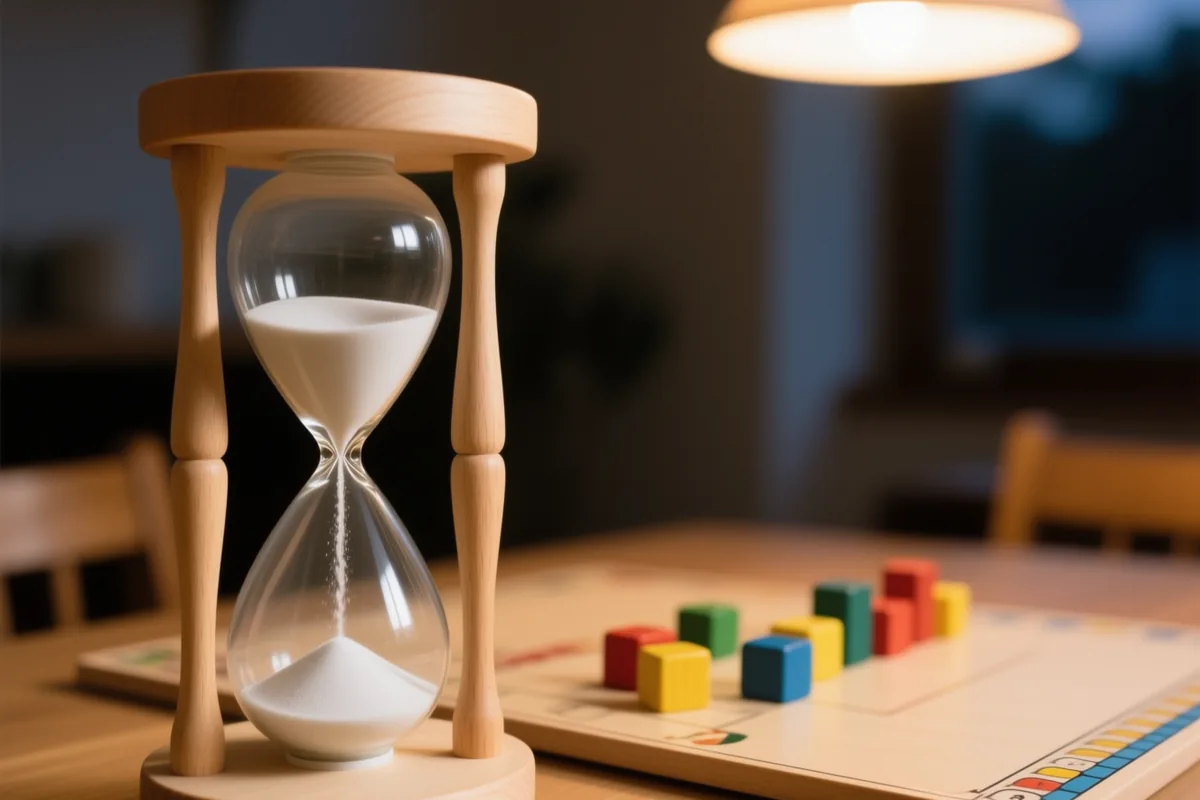
On the field of Iðavöllr, in the first age, the gods played at tables in the evening and had no want of gold. It is the only thing the poem records them doing before everything went wrong.
It does not say how long the game took. Nobody in the story had anywhere to be.
The rest of us are playing on a Tuesday.
The chart sorts by age and says nothing about time
Amazon’s board game chart, read this morning, is organised — without meaning to be — by the age of the player. Candy Land at one, Sorry! at two, Trouble at three, Connect 4 at four and five, Monopoly at nine.
What it does not tell you, anywhere, is how long anything takes. Which on a weeknight is the only question that matters. You do not have “a game” of free time. You have forty minutes between the washing up and someone needing to be asleep.
Sorted by that instead, the chart looks completely different, and most of what’s actually useful for a weeknight sits well below the top few slots — below every classic on it.
The under-an-hour shelf
- Ten to fifteen minutes: Twister at twelve, Connect 4 at four, Guess Who at seven, Operation at eighteen.
- Fifteen to twenty: Codenames at eleven, Tapple at ten.
- Twenty to thirty: Hedbanz at sixteen, Hues and Cues at six.
- Over an hour, despite the rank: Catan at eight, Monopoly at nine, Scrabble at seventeen.
That last line is the one to notice. Two of the chart’s top nine are games that take a whole evening, sitting alongside games that take a quarter of one, with nothing on the page to distinguish them. Somebody buying Monopoly at number nine because it ranks well, for a family with a seven-year-old and a bedtime, has bought an argument.
What makes a game fit an hour
Three things, and they are worth knowing because they let you judge a box you have never heard of:
No setup. If the box needs ten minutes of sorting before anyone plays, it is not a weeknight game regardless of what the play time says.
Teachable in under two minutes. The clock on a game evening starts when people sit down, not when play begins. A game that needs the rules read aloud has already spent a third of its hour.
It ends on its own. The best short games have a fixed number of rounds. Games that end when a condition is met — someone reaching a score, someone going bankrupt — take exactly as long as the table’s worst decisions, which is why Monopoly is famous.
Every game on the under-an-hour shelf above passes all three. Connect 4 and Guess Who pass them too, which is why they are up there. Monopoly, at number nine, fails the third outright — and that single fact is the whole reason it has the reputation it has.
Where these picks came from, honestly
All three read off Amazon’s own board game chart this morning — node 166225011 — rank, rating and review count together, best-sellers first. All three are research picks as listings. The play-time groupings are our own, drawn from the published times and from having run a game shop counter for four years, where “how long does it take” was the second question after price and the first one that actually predicted whether a game came back.
The one honest warning
The Codenames listing at number eleven carries 272 ratings. Its neighbours on the chart carry ten and fifteen thousand.
We are recommending it anyway, and it is worth being precise about why, because the reasoning matters more than the pick.
Codenames the game is a decade old, has sold millions of copies and has been reviewed by an enormous number of people. The listing at number eleven is a second edition, freshly created, and a new listing starts its review count at zero and inherits none of the original’s record. 272 reviews is not a verdict on a proven game; it is a measure of how recently the box changed.
The trap is that this cuts both ways, and the chart will not tell you which one you are looking at. A low review count high on a chart is either a proven thing in a new box, or an unproven thing riding advertising. The only way to tell is to know whether the game has a history, which is a question about the world and not about the listing.
When you cannot tell, the safe reading is the pessimistic one. Here, we can tell.
The picks
Spin Master Hedbanz Picture Guessing Game
Number sixteen on Amazon's board game chart, 4.8 stars across 2,454 ratings — a fast, loud guessing game built around a headband and a picture card, where the point is asking yes-or-no questions to work out what's on your own head before anyone else guesses first. Fifteen to twenty minutes, scales easily to a full table, and needs no setup beyond dealing the cards.
- Best for
- Mixed-age groups old enough to read the cards, and any table that wants something loud and fast rather than strategic.
- Watch out
- The deck leans on recognisable pop culture and simple categories, so it plays best when the table shares a similar frame of reference — a very mixed-generation group will get uneven results.
CGE Codenames, 2nd edition
Number eleven, and the best word game on this chart by a distance: two teams, a grid of words, and a one-word clue that has to link several of them without pointing at the assassin. Fifteen minutes a round, teaches in two, and scales from four players to a room. The game itself is a decade old and thoroughly proven — but see the warning about this particular listing before you read anything into its star rating.
- Best for
- Four or more, mixed ability, and groups that want to think without learning rules.
- Watch out
- It genuinely needs even teams and at least four people; the two-player variant exists and is a different, lesser game. And this is a new edition listing with very few reviews — the rating you see is not the game's record.
Hasbro Twister party classic
Number twelve, 4.7 stars across fifteen thousand ratings, and on this list as the honest reminder that not every short game is a card game. Ten minutes, no reading, no rules to teach, and it is the only thing in the top twenty that gets people off the sofa.
- Best for
- Younger children, parties, and breaking up a long evening of sitting down.
- Watch out
- It needs floor space most living rooms do not have once the furniture is in, and it is genuinely unsuitable for anyone with a bad back, knee or shoulder. That is a larger share of any adult gathering than the box admits.
We do not list prices; they change daily. The button opens the current Amazon page.