
D&D Dice and Minis: What a Table Actually Needs
Dice and miniatures were the number two seller in our shop years. Here is the bulk-versus-individual decision on both, and what a table genuinely needs.
Iðavöllr is the field where the gods played their game, and where the pieces were found again in the grass. Somebody has to bring the pieces.
Number two at the register
We asked what actually sold in the four years one of us ran a game shop. Magic was first, on accessories rather than cards. Second was D&D miniatures and dice.
That ranking makes sense once you have stood behind a counter. Dice and minis are the perfect shop product: cheap enough to buy on impulse, needed in multiples, and nobody ever considers themselves finished. A player who owns dice will still buy dice.
Which means the useful question is not which — it is how many, and when does the expensive version earn it. Both halves have the same answer shape.
Dice: buy for the table, not for yourself
The standard mistake is buying one set. A table needs a set per player, because passing dice around slows a game to a crawl and everyone wants their own anyway.
Five sets for under nine dollars is the honest starting purchase. Every player gets a set and a pouch, and the DM stops lending theirs out and never getting them back.
Beyond that there are two separate hobbies and it is worth knowing which you are in:
- Playing needs seven dice per person, and cheap acrylic is completely adequate.
- Collecting is about how they look and feel, and there is no ceiling on it. Metal, sharp-edge, handmade resin — all legitimate, none of it makes you roll better.
If someone tells you cheap dice are unbalanced: they are, slightly. It does not matter at a kitchen table and it is not worth an argument. If it genuinely bothers you, precision dice exist and cost about ten times as much.
We also wrote about the rest of the table — mats, markers and keeping initiative straight — in our weekly-group piece.
Minis: bulk for the horde, good ones for the names
This is the decision people get wrong, usually by buying beautifully sculpted individual miniatures for creatures that will be dead in four rounds.
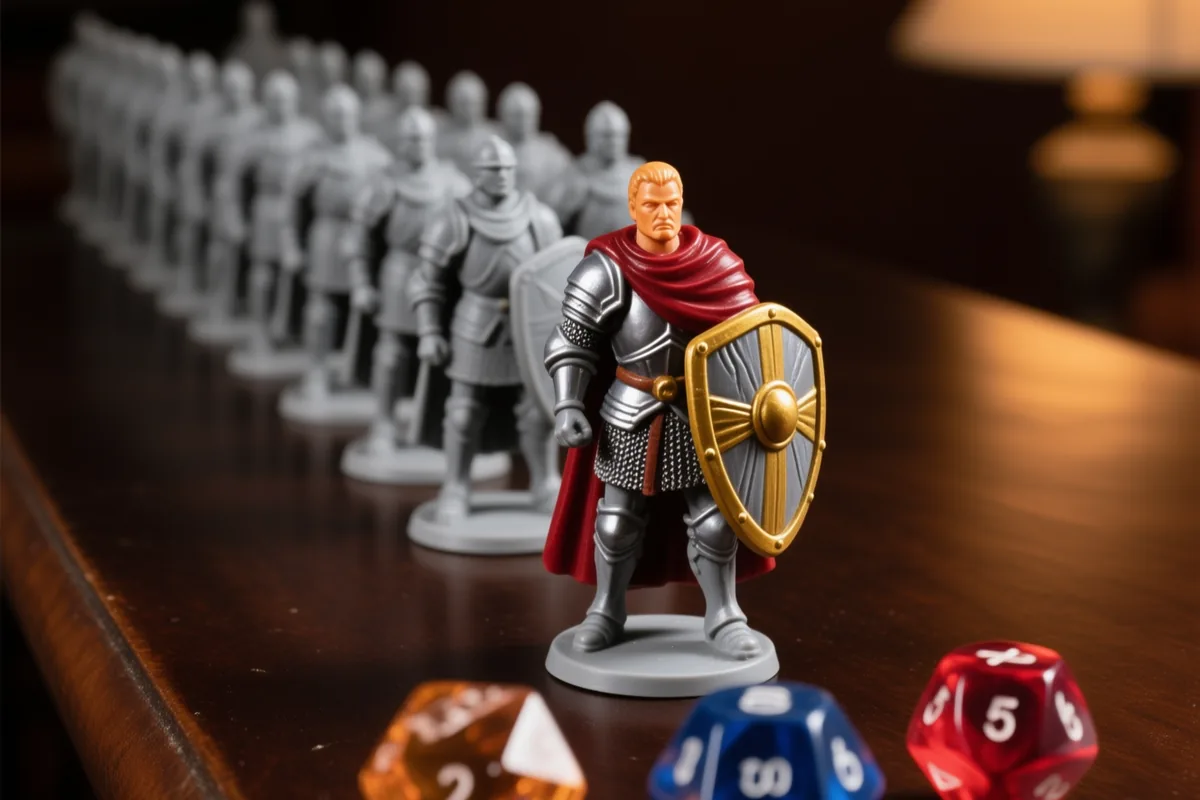
A DM needs bodies on squares. Twelve goblins, six skeletons, a couple of ogres. Nobody at the table is admiring the sculpt on goblin number nine — they need to know where it is standing. A bulk set of sixty-plus figures works out around sixty-five cents each and solves that permanently.
Then buy the good ones for the things that matter. The official WizKids sculpts are genuinely nicer, primed and ready to paint, at roughly nine to thirteen dollars a pack. That is the right spend for a player character you will look at every week for two years, or a villain the campaign is named after.
Getting this backwards is expensive. A full monster roster at ten dollars a figure costs more than everything else at the table combined.
On the bulk sets specifically: they arrive soft, and weapons bend in the box. Hot water then cold straightens them in seconds. That is not a defect, it is what cheap PVC does.
The One Big Exception
There is a third category, and it is exactly one figure: the thing at the end.
If your campaign has been building toward a dragon for a year, a 28mm dragon on a small base is a let-down at the moment it matters most. The Gargantuan Red Dragon in the WizKids Deep Cuts line is the one people actually buy for this — around 2,200 ratings against the low hundreds for most dragon sculpts, which in a niche this small is a landslide.
Be honest with yourself about when to spend it, though. Fifty dollars is one monster, and the table sees it for one session. If you just want a dragon on the board this month, the young red dragon in the Nolzur’s line is about twelve dollars and nobody will complain.
Where we stand on these two. We do not own either one, and we are not going to pretend otherwise. What we can tell you is that the person here who spent four years selling this category across a shop counter looked at both and said he would buy them with his own money. That is an opinion rather than a review — but it is an informed one, from someone who watched which dragons people actually carried to the register, and we would rather hand you that than a paragraph of hedging.
The rule holds either way: bulk for the horde, good ones for the names, and exactly one figure that makes the room go quiet.
What you do not need yet
Paint. Not at first.
Unpainted grey plastic works perfectly well for a year, and painting is its own hobby with its own gear and its own learning curve. Plenty of people discover they love it. Plenty buy a starter paint set, do three figures badly, and never open it again.
Play with grey minis. If you find yourself wanting them painted, that desire will still be there in six months and you will know it is real.
The honest summary
Five sets of dice so everyone has their own. A bulk box of monsters so the DM can put something on the square. One good figure for the character you actually care about. That is a complete table for under sixty dollars, and it is genuinely most of what a group needs that a group usually does not have.
The picks
SmartDealsPro polyhedral dice, 5 sets of 7 with pouches
Five complete seven-die sets for under nine dollars, each in its own pouch. That is one set per player at a typical table, which is the actual unit of purchase — not one set, five.
- Best for
- Outfitting a whole group, or a DM who needs a pool nobody has to borrow from.
- Watch out
- Budget acrylic dice have soft edges and occasional bubbles. Fine for play, not balanced enough to argue about — if that matters to you, buy precision dice instead.
CiaraQ polyhedral dice set
The most-reviewed dice on Amazon by a distance — 4.8 stars across more than twenty thousand ratings. When a cheap product holds that rating at that volume, it is doing the job.
- Best for
- A player who wants one good-looking set that is theirs.
- Watch out
- Dice sets are the single easiest thing to over-buy. You need seven dice. The rest is collecting, which is fine — just know which one you are doing.
D&D miniatures bulk set, 64 unpainted 28mm with boss monsters
Sixty-four bodies for about sixty-five cents each. A DM does not need a perfect sculpt of the specific monster — they need something on the square that everyone agrees is a goblin.
- Best for
- Any DM running combat, and anyone starting from nothing.
- Watch out
- Bulk sculpts are soft and the plastic is bendy out of the box. A dip in hot then cold water straightens a warped weapon.
WizKids Pathfinder Battles Deep Cuts, Gargantuan Red Dragon
The best-selling dragon miniature on Amazon by a wide margin - around 2,200 ratings at 4.8, where most dragon sculpts sit in the low hundreds or lower. Gargantuan means it actually covers the squares a dragon is supposed to cover, which is the whole reason a boss figure earns its place.
- Best for
- The dragon a campaign has been building toward for a year.
- Watch out
- It is around fifty dollars for one monster. Buy it when the dragon is genuinely the climax - a Nolzur's young red dragon is a third of the price if you just need a dragon on the board this week.
D&D Nolzur's Marvelous Unpainted Miniatures, Wave 1: Skeletons
The official WizKids line, primed and genuinely well sculpted, around nine dollars for the pack. This is what you buy for a player character or a boss that matters — not for the fortieth goblin.
- Best for
- The one figure that represents your character for two years.
- Watch out
- Buying a table's worth of monsters this way costs more than the campaign. Use bulk for the horde and Nolzur's for the ones with names.
We do not list prices; they change daily. The button opens the current Amazon page.