
What the Puzzle Chart Says People Finish
Amazon's puzzle chart opens with a puzzle board, a Rubik's Cube and a brain teaser. A baby play mat sits at seven. Actual jigsaws are the minority on it.
Odin went to the giant Vafthrúdnir’s hall to hold a contest of riddles, with both their heads as the stake. They traded questions about the beginning and the end of the world, and the giant answered every one.
Odin won by asking what he had whispered in his own dead son’s ear. It was not a riddle. It was a question with exactly one possible knower.
Puzzles have a long history of not quite being what they claim to be, which brings us to the chart.
The puzzle chart is mostly not puzzles
Amazon’s Puzzles chart, read this morning. Top eleven:
- A puzzle board — an accessory.
- A Rubik’s Cube.
- A 3D brain teaser.
- An 18-piece children’s jigsaw.
- A 1000-piece Halloween jigsaw.
- A set of wooden dinosaur puzzles.
- A baby play mat — foam floor tiles.
- A 500-piece Halloween jigsaw.
- A wooden toddler puzzle.
- A 1000-piece Halloween jigsaw.
- Puzzle glue.
Set aside the accessories and the miscategorised play mat and you are left with six actual puzzles, three of which are Halloween-themed and seasonal.
The number one product is a board to do a jigsaw on. Number eleven is glue for sticking a finished one down. The two things bracketing this chart are both about the problem of where a jigsaw lives, which is the most honest thing any chart has told us about a hobby.
The real constraint is the table, not the puzzle
That is worth taking seriously, because it explains the shape of the whole category.
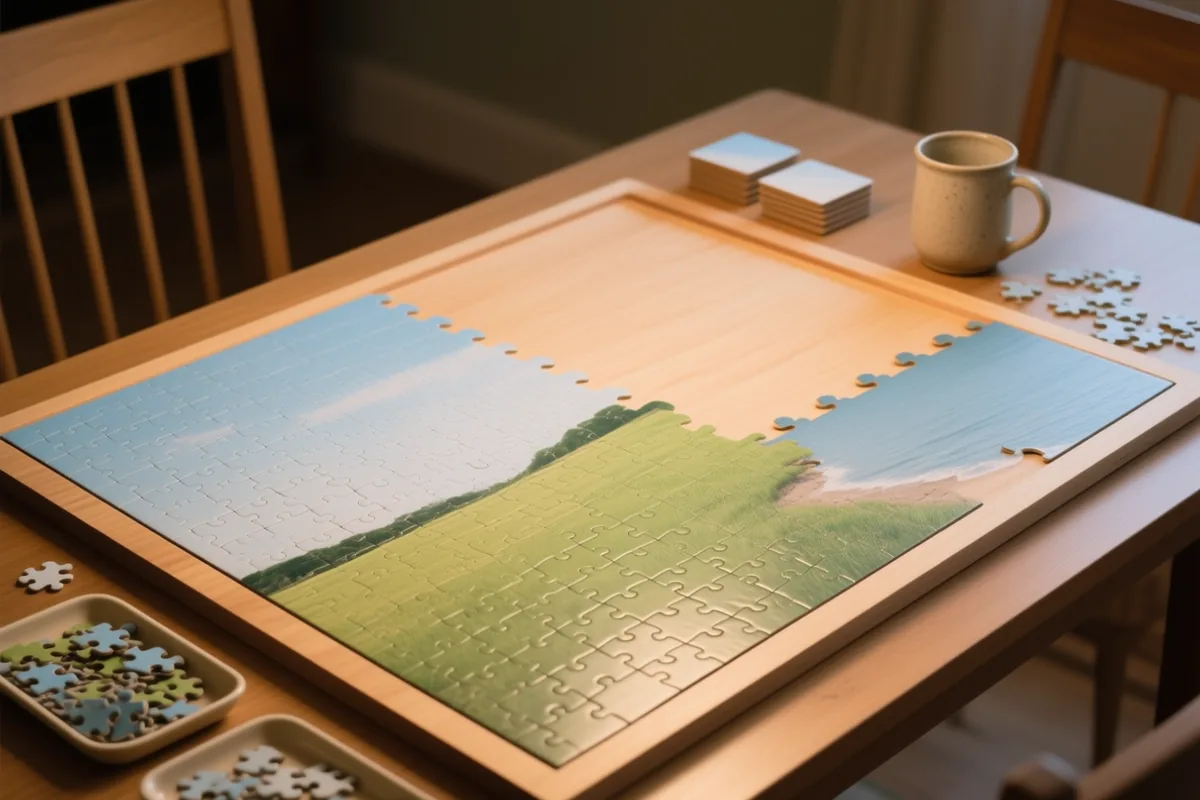
A 1000-piece jigsaw takes several evenings and occupies roughly two feet by three the entire time. Most households do not have a surface that can be surrendered for a week. So the actual obstacle to doing puzzles is not difficulty or price — it is furniture, and the market has responded by selling boards, mats, roll-up cases and glue.
Anyone buying a first proper jigsaw should buy the board at the same time, or accept that the puzzle will be done in one sitting or not at all.
Three different hobbies in one chart
Worth separating before you buy, because the word covers products with nothing in common:
- Jigsaws — several hours, one to three people, needs a table. The social, slow one.
- Mechanical and logic puzzles — the Cube at two, Kanoodle at three. One person, minutes to hours, fits in a pocket, and reusable in a way a jigsaw is not.
- Toddler puzzles — four, six and nine. Not a leisure activity at all; a developmental toy about shape matching and pincer grip.
The single-player pocket puzzles are the ones with the review counts — Kanoodle’s thirty-five thousand is more than any jigsaw on the chart. The chart is telling you that the puzzles people finish are the small ones they can carry.
Where these picks came from, honestly
All four read off Amazon’s own Puzzles chart this morning — node 166359011 — rank, rating and review count together, best-sellers first. All four are research picks. The count of what is actually a puzzle on that chart was done by hand, and the point about table space is the sort of thing anyone who has left a jigsaw out through a family dinner will recognise.
The one honest warning
Three of the six real jigsaws on this chart are Halloween products, and two of them carry two hundred and thirty and three hundred and twenty ratings.
We are reading this chart in early September. Those listings are riding a seasonal spike — bought heavily for six weeks, ranked accordingly, and carrying review counts that would put them nowhere near a top ten in March.
That is a specific and useful thing to understand about every best-seller chart, not just this one. Rank is a measure of recent velocity, and seasonal products are the purest form of velocity there is. A Halloween jigsaw at number eight in September is not a better puzzle than one at number forty; it is a puzzle being bought right now by people who will not buy it again until next year.
The practical version: when a chart’s ranking looks strange for the time of year, check the theme before the rating. Christmas products will do exactly the same thing to these charts in about eight weeks, and a listing’s star average built from a few hundred seasonal buyers tells you almost nothing about the product and quite a lot about the calendar.
The Kanoodle at number three has thirty-five thousand ratings and sells all year. That is a different kind of number, and it is the kind worth trusting.
The picks
Educational Insights Kanoodle 3D brain teaser puzzle
Number three on Amazon's Puzzles chart this morning, 4.7 stars across thirty-five thousand ratings — **the most-reviewed product on the chart by a distance.** A pocket-sized case of plastic shapes and two hundred challenges of increasing difficulty, each with exactly one solution. It ranks where it does because it is the rare puzzle that is genuinely one player, genuinely portable, and has a difficulty curve rather than a single wall.
- Best for
- Ages roughly seven upward including adults, car journeys, waiting rooms, and anyone who wants a puzzle that fits in a coat pocket.
- Watch out
- It is single-player and silent, which is the opposite of a game-night purchase. The later challenges are properly hard, and the booklet is the whole product — lose it and you have a bag of plastic shapes.
Rubik's Cube, the original 3x3
Number two, 4.7 stars across ten thousand ratings. Fifty years old and still the second best-selling puzzle in the country. Worth knowing what has changed: the modern official cube turns far better than the stiff, corner-catching thing anybody over thirty-five remembers, which removes the main reason people gave up on it in about 1982.
- Best for
- One person, repeatedly, and anyone who has never learned that the cube is solved by memorising a handful of move sequences rather than by insight.
- Watch out
- It is a memorisation puzzle, not a logic puzzle, and nobody works it out unaided — a beginner method is a twenty-minute video and it is not cheating. Speedcubers buy a different, looser cube; this is the official one.
ALL4JIG 1500 piece rotating puzzle board with 4 drawers
**Number one on the whole chart**, 4.5 stars across nine thousand ratings — and it is not a puzzle. It is a board to do one on: a felted rotating surface with drawers for sorting, so a half-finished jigsaw can be turned round, tidied away and put on a shelf. The best-selling product in the puzzle category is furniture for the hobby, which tells you what the actual obstacle is.
- Best for
- Anyone doing 1000-piece puzzles on a table the household also needs to eat at.
- Watch out
- It is large, and a 1500-piece board is bigger than most dining tables can spare. Check the dimensions against the puzzle sizes you actually buy — and against where it will live when it is not in use, which is the question people forget.
Melissa & Doug farm wooden chunky puzzle, 8 pieces
Number nine, **4.8 stars across seven thousand seven hundred ratings — the highest rating on the chart.** Eight thick wooden pieces with knobs, each sitting in its own recess. For a toddler this is the first puzzle that works, because chunky pieces suit hands that cannot yet pinch and the recesses give immediate, obvious feedback.
- Best for
- Roughly eighteen months to three years, and a first puzzle that will survive being stood on.
- Watch out
- Eight pieces is outgrown quickly — a year, perhaps less. Buy it for the age it fits rather than as something that will last, and pass it on.
We do not list prices; they change daily. The button opens the current Amazon page.