
October Is the Desert Spring
Phoenix plants its real spring in October. What the seed and soil charts are selling right now, and what a low-desert fall planting actually needs.
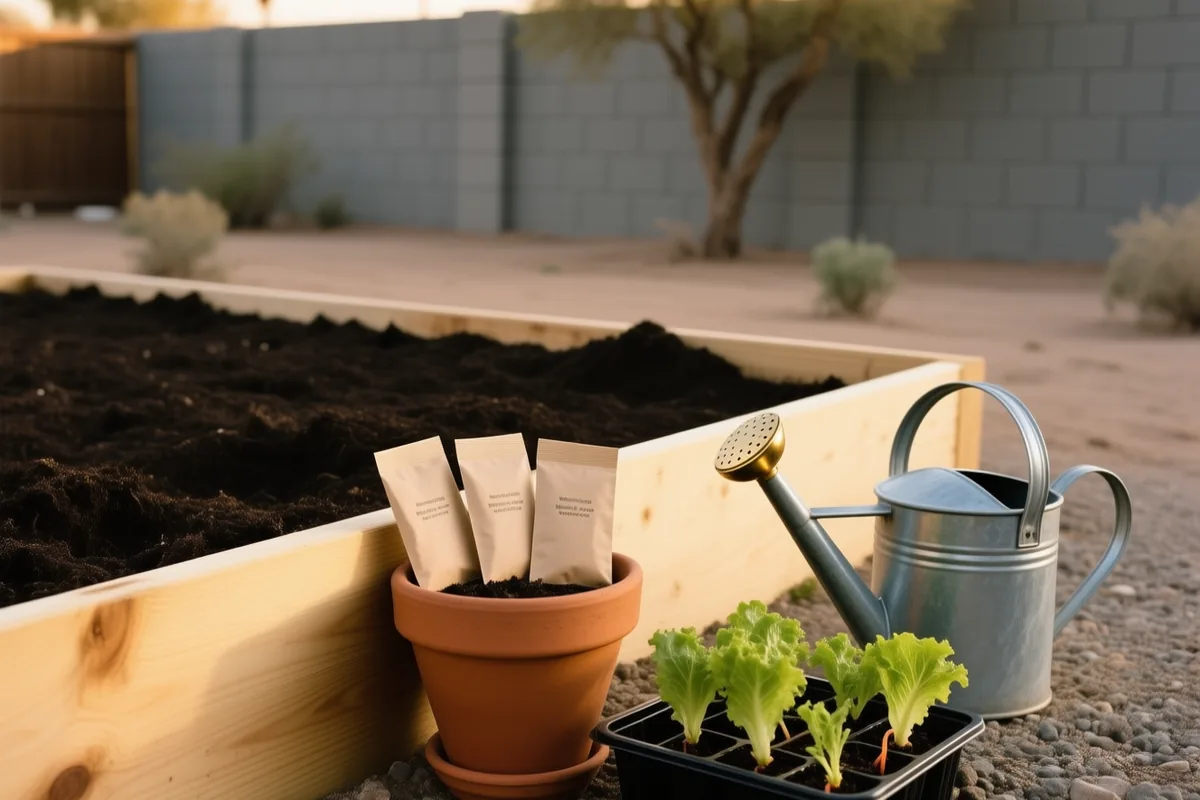
Freyr saw the giantess Gerðr from Odin’s high seat and could not eat or sleep afterward. He sent his servant to court her, and she named her terms: she would meet him in the grove of Barri, in nine nights. Freyr’s answer is the only line of that story anyone remembers.
Long is one night. Longer are two. How shall I bear three?
Nine nights is nothing. Ask anyone who has sown carrots.
In September the garden chart is a pest-control chart
Amazon’s Patio, Lawn and Garden chart, read this morning, and the Gardening sub-chart under it are close to the same list. Both open the same way.
- Numbers one through eight are insects. Flying insect traps, ant bait, fruit fly traps, wasp spray, a perimeter insect killer. Eight of the top eight.
- Number nine is the herb seed kit — the first thing on the chart you plant rather than kill.
- Then a pump sprayer, a garden hose, roach gel, and carrot seed at thirteen.
Two of the top fifteen are seeds. This is not a gardening chart in September. It is a chart of people trying to make the outdoors stop, which is the correct thing to be doing in most of the country right now, and exactly the wrong month to take planting advice from.
Here, October is the planting month
The low desert runs its calendar upside down against the rest of the country. Our killing season is July and August. Our growing season opens when the nights drop out of the nineties and runs through to the following May.
So the fall planting is the real one. Lettuce, spinach, carrots, beets, radishes, chard, peas, cilantro, dill, parsley — all of it goes in from early October, and all of it is the seed rack’s spring section, sold to us in a month the packet does not mention. The seed packet says “sow after last frost.” Our last frost is in February and the ground is unworkable by May. The packet was not written for us.
The practical version: the herb kit and the carrot seed on this chart are both October crops here and both are being bought right now by people planting them in the wrong season somewhere else. Buy them on the chart’s rank, plant them on our calendar.
What the soil chart is really selling
The Soils, Mulches and Planting Media chart has almost no mulch on it. The top fifteen this morning are potting mixes, a succulent and cactus mix at number one, perlite, five separate Miracle-Gro fertilizers and three more Miracle-Gro potting mixes. It is a houseplant chart wearing a garden name.
That matters for a fall bed because the two things a low-desert seed bed actually wants — organic matter worked in, and three to four inches of coarse mulch on top — are the two things this chart does not sell. Compost and bark come by the cubic yard from a local yard, and they are heavy, cheap and bad at being shipped. The chart sells what ships.
Where these picks came from, honestly
All four were read off Amazon’s own charts this morning, rank, rating and review count together, best-sellers first. All four are research picks. The planting calendar around them is not — that part is living and gardening in the low desert, where the fall planting window is the one thing every local gardener agrees on and every seed packet gets wrong.
The one honest warning
The herb kit carries 4.2 stars on sixty-five thousand ratings. Only one thing in the garden top ten scores lower — a fruit-fly trap at 3.9 — while the wasp spray, the ant bait and the flying-insect trap above it sit at 4.7, 4.6 and 4.8. That is a lot of people, and a real gap.
Read what a bad review of a seed kit usually is before you decide it matters. Most of them are germination failures, and most germination failures are the buyer’s soil temperature, sowing depth or watering rather than dead seed — which is precisely why a kit like this gets a lower score than a can of wasp spray that either works or does not. A 4.2 on seeds and a 4.2 on a hose nozzle are not the same number.
But some of it is real. Fifteen varieties in one box means small counts of each, and a variety pack is the format most likely to include something that does not suit your season at all. If you want one crop to come up, buy the single packet of that crop. Buy the kit for the reason it is good: it is a cheap way to find out which five of fifteen herbs actually like your yard, and October is the month to run that experiment.
The picks
HOME GROWN 15 Herb Seed Variety Kit, 4,300+ seeds
Number nine on the Patio, Lawn and Garden chart this morning and number nine again on the Gardening sub-chart, 4.2 stars across sixty-four thousand nine hundred ratings. It is the only seed product in the top ten of either chart. Herbs are the right thing to hand a first-time low-desert grower, because most of the list — basil, cilantro, dill, parsley, chives — is a cool-season crop here and October is when it wants to go in.
- Best for
- A first fall planting, a raised bed you want producing something by Thanksgiving, and anyone who has killed basil in July and concluded they cannot grow herbs.
- Watch out
- Fifteen varieties in one kit means fifteen different sowing depths and germination times, and the packets do not sort themselves. Cilantro bolts the moment it warms, so it wants to go in last and get pulled first. And see the warning at the bottom of this piece — this carries one of the two lowest ratings in the garden top ten and the reason is worth reading.
Tendersweet Carrot Heirloom Vegetable Seeds, 3,100 seeds
Number thirteen on the Gardening chart and fourteen on the main garden chart, 4.1 stars across nine thousand nine hundred ratings. Carrots are the crop that makes the case for fall planting better than anything else on the chart: they germinate in warm soil, size up in cool weather and get sweeter after the first cold night. Planted here in October they are ready around the New Year. Planted in spring they run into May and turn woody.
- Best for
- Deep raised beds, containers at least ten inches deep, and gardeners who want one crop that clearly rewards planting at the right time instead of the convenient time.
- Watch out
- Carrot seed is tiny and shallow-sown, which means the top half inch of soil cannot be allowed to dry out for two to three weeks — in low-desert October that is a light watering twice a day, not once. They also fork and stunt in rocky or heavy ground, so this is a seed that wants loose media, not native caliche.
Miracle-Gro Potting Mix, 16 qt, 2-pack
Number fourteen on the Soils, Mulches and Planting Media chart, 4.7 stars across twenty-one thousand six hundred ratings — the highest-rated large seller in that top fifteen. Worth knowing what that chart actually is: of the top fifteen, thirteen are fertilizer or growing media and not one is mulch. If you want bark or straw you are buying it locally, by volume, not from this chart.
- Best for
- Containers and filling a new raised bed, where native desert soil is the problem and not the foundation.
- Watch out
- It is a container mix, not a soil amendment. Spread across an in-ground bed it holds water at the surface and dries out below, which is the opposite of what you want here. And it comes pre-fertilized, so adding more feed in the first month burns young seedlings.
Back to the Roots 100% organic perlite
Number eight on the Soils, Mulches and Planting Media chart, 4.8 stars — the highest score anywhere in that top fifteen, on one thousand one hundred ratings. Perlite is puffed volcanic glass and it does one thing: it keeps a mix open so water drains through and air gets to the roots. In a climate where a fall seed bed gets watered twice a day for three weeks, drainage is the difference between germination and rot.
- Best for
- Cutting into a heavy potting mix, starting seeds in trays, and containers that sit on a hot patio and get watered daily.
- Watch out
- It is dust when it is dry and the dust is unpleasant to breathe — wet the bag before you pour it. It also floats, so it works its way to the surface of a container over a season, which looks like a problem and is not. Buy it as an amendment to a mix, never as the mix.
We do not list prices; they change daily. The button opens the current Amazon page.