
The Indoor Gardening Chart Has No Light On It
The indoor growing chart is fertilizer and potting mix top to bottom. It sells no grow light at all, and light is what actually limits a houseplant.
Sol drives the sun across the sky with the wolf Skoll a stride behind her, and she has never once been able to slow down. The light in the Norse world is not a place or a possession. It is a thing on a schedule, moving whether or not anyone is ready, and at Ragnarok the wolf finally catches her and the world goes dark.
The chart is food and dirt, and nothing else
Amazon’s soils and planting media chart is where indoor growing products actually live. The top twenty, sorted:
- Seven fertilizers — liquid feeds, water-soluble, granular
- Six growing media — potting mixes, succulent mixes, perlite
- Two pest and disease products, and beyond the top fifteen, more of the same
There is no grow light. No lamp, no bulb, no LED panel, no light meter, nothing that produces a photon. On the chart that sells indoor gardening, the input that actually limits indoor gardening does not appear.
Why that matters more than the mix
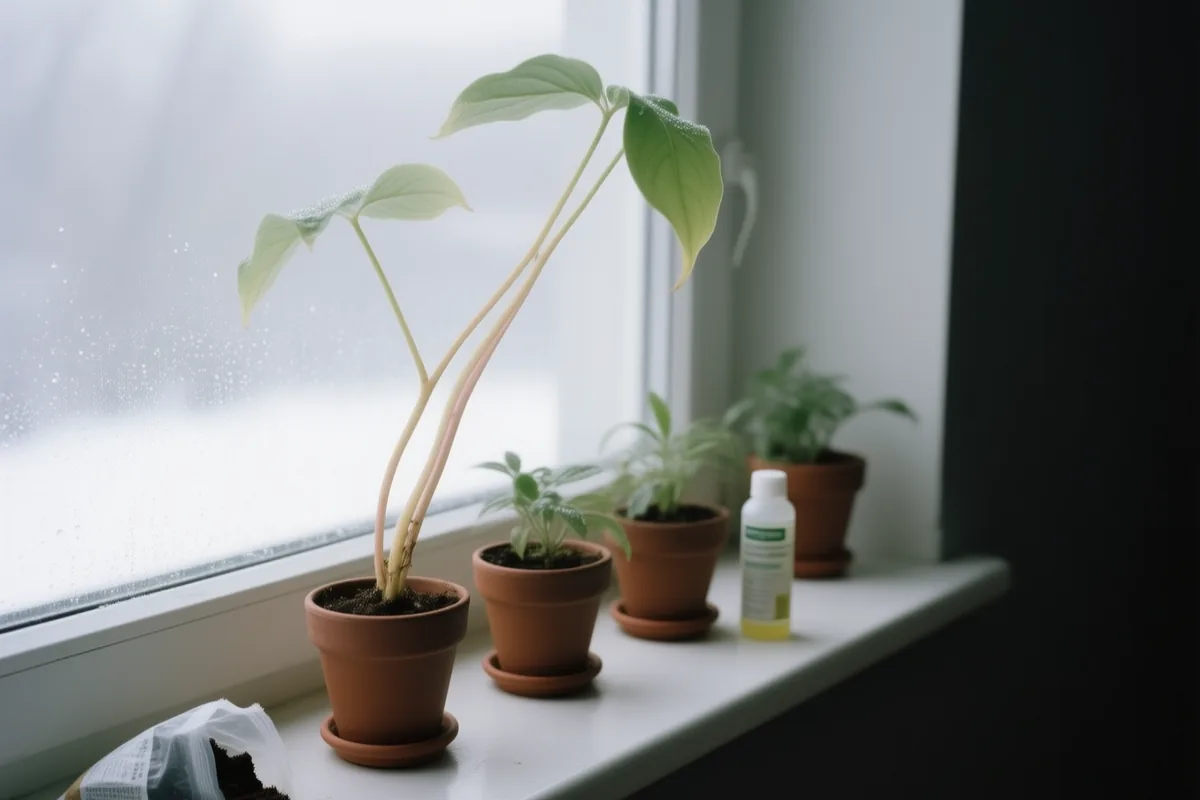
Almost every houseplant that dies indoors dies of one of two things: too much water, or not enough light. And of those two, light is the one people never diagnose, because a plant starved of light does not look sick. It looks stretched — long pale gaps between leaves, new growth smaller than old growth, everything leaning one way.
That is not a nutrient problem and no amount of feeding fixes it. Feeding a light-starved plant makes it grow faster in the wrong direction.
The numbers are unintuitive. A bright north-facing room that feels perfectly well lit to a person is a fraction of the light available a foot inside a south-facing window, and both are a rounding error against outdoors on a cloudy day. Eyes adapt; plants do not.
What an indoor kit should actually contain
Light first. Either a window that genuinely gets direct sun for some part of the day, or a lamp. Everything else is downstream of this.
Then the right mix, which indoors means lighter and more open than garden soil, because there is no wind, no sun and no drainage to save you from a dense pot.
Then feed, because a pot is a closed system and the mix’s starter charge is gone within a season.
Then a pot with a hole in it. The single most common cause of houseplant root rot is a decorative pot with no drainage, and it costs nothing to fix.
Where these picks came from, honestly
Ranks, ratings and review counts read straight off Amazon’s soils, mulches and planting media chart this morning, best-sellers first, with every candidate checked against the products already used elsewhere on this site. Chart node 3752871.
These are research picks. All nine of our existing garden articles are outdoor desert pieces, so the houseplant buyer has genuinely never been addressed here before, and we are not going to pretend to an indoor collection we do not have. The light reasoning is well-established horticulture rather than our measurement.
The one honest warning
Every one of the four picks above is a Miracle-Gro product, and that is a fact about the chart rather than a recommendation.
Read the top fifteen of this category and you will find the same brand at two, three, four, eight, eleven, thirteen, fourteen, fifteen and sixteen. That is not a conspiracy — it is a very large company with excellent distribution in a category where most competitors are regional or bulk.
But it does mean this chart is closer to one company’s product line than to a competitive ranking, and a best-seller list that is mostly one brand cannot tell you whether that brand is best. It can only tell you it is everywhere.
If you want to test that for yourself, buy one bag of a smaller brand’s mix alongside one of these and use them on two halves of the same plant collection. That is a genuinely useful experiment and no chart will ever run it for you.
The picks
Miracle-Gro Houseplant Potting Mix, 4 qt.
Number sixteen at 4.6 stars across 7,724 ratings. A houseplant-specific mix is lighter and holds more air than general potting soil, which matters indoors where a pot never dries out from wind or sun and root rot is the leading cause of death.
- Best for
- Repotting anything that came home in a nursery pot, which is almost always the wrong mix in the wrong container.
- Watch out
- Four quarts is small. It is right for a few houseplants and wrong for a repotting afternoon, and the larger bags are much better value per quart.
Miracle-Gro Indoor Grow, Feed & Protect Houseplant Care Bundle
Number three at 4.7 stars across 20,859 ratings, the highest-placed bundle on the chart. Bundles usually deserve suspicion; this one earns its place because the three problems it addresses — food, pests, and mix — are genuinely the three that recur indoors.
- Best for
- Somebody starting with several plants at once who does not yet know what they will need.
- Watch out
- A bundle is a guess about your problem. If you already know your plants are hungry rather than infested, a single bottle of feed is the cheaper and more honest purchase.
Miracle-Gro Pour & Feed Plant Food, 32 fl. oz.
Number twenty at 4.6 stars across 7,298 ratings. Ready-to-use means no measuring and no mixing, which sounds trivial and is the actual difference between a plant that gets fed and one that does not.
- Best for
- Anyone whose concentrated fertilizer has been sitting unmixed in a cupboard since spring.
- Watch out
- Ready-to-use is dilute by definition, so a bottle does not go far and costs more per feed than concentrate. It buys consistency, not economy.
Miracle-Gro Indoor Plant Food, 8 fl. oz. (2-Pack)
Number two at 4.7 stars across 1,696 ratings, and the highest-rated feed in this chart's top five. A dropper bottle sized for indoor pots is the format that stops people over-feeding, which indoors is a more common mistake than under-feeding.
- Best for
- A small collection of houseplants in ordinary pots, fed through the growing season.
- Watch out
- Only 1,696 ratings against 20,859 for the bundle above. It is a newer listing rather than a worse product, but the evidence behind it is correspondingly thinner.
We do not list prices; they change daily. The button opens the current Amazon page.