
Dog Harness or Collar: What the Chart Says People Buy
Four of the top ten on Amazon's dog collar chart are harnesses; one is a collar. They are not alternatives — one of them has a job the other cannot do.
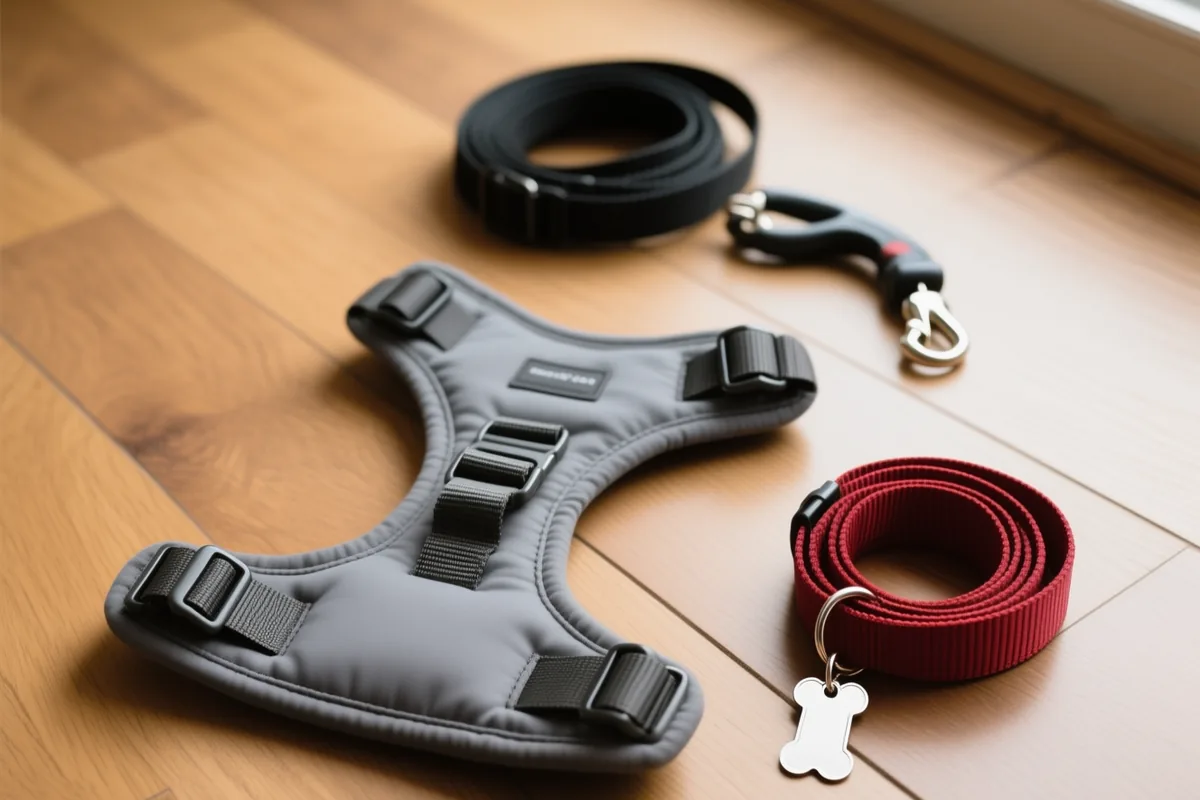
When the gods finally bound Fenrir, the price was Týr’s hand, and the reason the price was so high is that the wolf agreed to nothing. Everything before that was done to him.
The lead is the one piece of equipment in a dog’s life that is negotiated every single day. It is worth understanding what you are asking it to do.
What the chart says people buy
Amazon’s Dog Collars, Harnesses and Leashes chart, read this morning:
- Harness — step-in vest.
- Rope leash.
- Harness — no-pull, two clips, 197,000 ratings.
- Collar — reflective, padded.
- ID tags — 104,000 ratings.
- A shock collar.
- Harness — front clip.
- A long training line.
- A bark collar.
- Harness — no-pull.
Four harnesses in the top ten. One collar, and one set of ID tags.
That is a clear verdict on the walking question, and it hides the more useful point: the collar at number four and the tags at number five are not competing with those harnesses at all. They are doing the other job.
They are not alternatives
The confusion in this whole category comes from treating “harness or collar” as one decision. It is two.
Walking is a force question. A lead attached to a dog’s neck puts the entire load of a lunge or a pull onto the trachea and the cervical spine. On a small dog that is a genuine injury risk; on a large one it is a losing tug of war. A harness spreads that load across the chest, and a front clip removes the leverage entirely. This is why four of the top ten are harnesses and why nobody who walks a strong dog argues about it.
Identification is a presence question. A harness comes off in the house. A collar does not. When a dog goes through a gate at the wrong moment, what is on it is a flat collar with a tag, and whether it comes home in an hour or a week is decided by that one object.
So the honest answer is both, always, and they are not substitutes: the harness for the lead, the collar for the tag, the tag for the day it matters.
What the chart gets wrong
Numbers six and nine are a shock collar and a bark collar, sitting inside a top ten otherwise full of ordinary walking equipment.
That is the same pattern we found writing about puppies, and it is worth naming again: the category called training on these charts is overwhelmingly aversive devices, the veterinary behaviour bodies advise against them, and the evidence associates them with more fear and aggression rather than less. Number eight — a long training line — is the thing on that list that actually teaches a dog something.
If a dog pulls, the answer on this chart is a front-clip harness — number three has the review count, number ten is the design trainers name first — not the remote at number six.
Where these picks came from, honestly
All four read off Amazon’s own Dog Collars, Harnesses and Leashes chart this morning — node 2975339011 — rank, rating and review count together, best-sellers first. All four are research picks. The mechanical argument about load on the neck versus the chest is standard veterinary guidance rather than something we measured, and nothing here is veterinary advice.
The one honest warning
The most common serious injury on this page is not a pulled neck. It is a collar left on a growing dog.
A puppy’s neck thickens faster than anyone expects, and a collar is the one item nobody re-checks because it is always there. Left alone, it stops being loose, then stops being comfortable, and in the worst cases becomes embedded — a wound that requires surgery and that happens quietly, under fur, to dogs whose owners love them.
The rule is simple and it costs nothing: two fingers flat under the collar, checked every week until the dog is fully grown, and again whenever the coat changes with the season. The same check applies to every strap on a harness.
The second warning is smaller and worth stating anyway. Never attach a long line to a collar. A dog hitting the end of thirty feet at a run generates far more force than anything a normal walk produces, and that force has to go somewhere. On a harness it goes across the chest. On a collar it goes into the neck.
The picks
Voyager step-in air dog vest harness
Number one on Amazon's Dog Collars, Harnesses and Leashes chart this morning, 4.5 stars across sixty-nine thousand ratings. A step-in design is the easiest kind to get onto a dog that objects to things going over its head, which is most young dogs and nearly every rescue with a history. Soft mesh, no pressure on the throat, and the buckles sit on the back where a dog cannot chew them.
- Best for
- Small and medium dogs, puppies learning to be handled, and any dog that ducks away from an overhead harness.
- Watch out
- It clips at the back only. A back clip gives a strong dog leverage to pull against — physics, not training — so for a determined puller this is the wrong shape and the front-clip type below is the right one.
PetSafe Easy Walk no-pull dog harness
Number ten on the same chart, 4.3 stars across forty-nine thousand ratings, and the front-clip design that most trainers name first. The lead attaches at the chest, so a dog pulling forward turns itself gently back towards you instead of towing you down the street. It is not a correction and it does not hurt — it simply makes pulling stop achieving anything, which is the only thing that ever changes the behaviour.
- Best for
- Any dog that pulls, and the months of a young dog's life when it is learning that the lead is not a tug of war.
- Watch out
- Its 4.3 is the lowest rating of the four harnesses in the top ten, and the complaint is consistent: it rides and rubs if the fit is even slightly off, and the martingale loop at the chest needs to sit centred. This is a harness that rewards reading the fitting guide, which almost nobody does.
Joytale reflective dog collar, adjustable neoprene padded
Number four, 4.6 stars across sixty-two thousand ratings, and on this list for a job no harness does: it stays on the dog all the time, and it carries the identification. Reflective stitching is worth having for the same reason it is worth having on a coat — most dog walking in winter happens in the dark.
- Best for
- Everyday wear, identification, and every dog regardless of what you walk it on.
- Watch out
- A flat collar is for identification and light lead work, not for restraining a dog that lunges — that load belongs on a harness. Check the fit on a growing puppy weekly; a collar left unadjusted is the most common cause of a genuinely nasty injury on this whole page.
GoTags stainless steel personalised pet ID tags
Number five, 4.7 stars across one hundred and four thousand ratings — more than any harness on the chart except one. Eight lines of engraving on stainless steel. It is the cheapest item in this article and the only one that has ever got a dog home on its own.
- Best for
- Every dog, permanently, and a spare kept in a drawer for when the first one wears out.
- Watch out
- Put a phone number on it, not the dog's name — a name is what someone else uses to call your dog away from you. Engraving wears; read it once a year and replace it when you have to squint. A microchip is the backup, not the substitute, because a chip needs a scanner and a tag needs a stranger with a phone.
We do not list prices; they change daily. The button opens the current Amazon page.