
What's Missing From a Camping First Aid Kit
The camping safety chart sells eight lighters, four hand warmer packs and exactly one first aid kit. What a bought kit leaves out, and what belongs beside it.
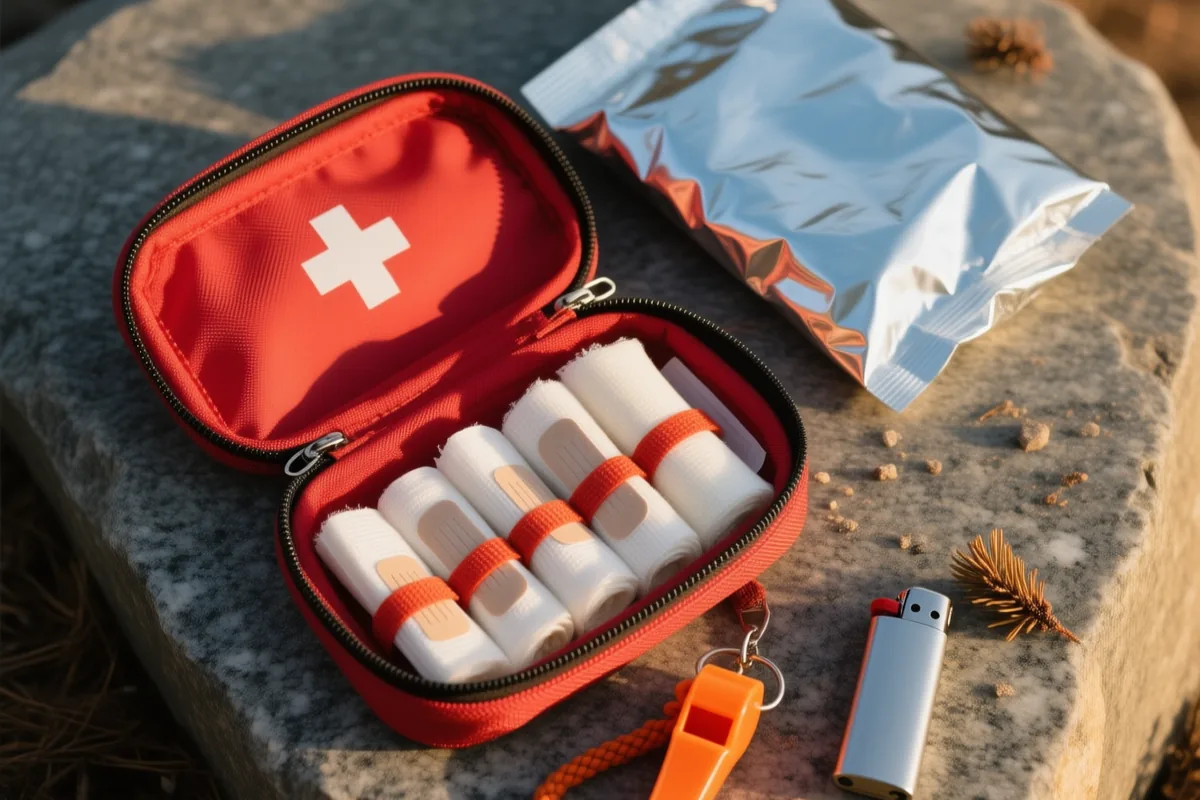
Eir is barely in the stories. She tends the wounded, she is counted among the healers, and the sagas move on to the fighting. The tellings remember the sword and forget the one who closes the wound — which is roughly how everyone packs for a camping trip.
Eight lighters. One first aid kit.
Amazon calls the chart Camping Safety & Survival Equipment. Sorted by what the top twenty products actually are:
- Nine lighters — arc, butane, refillable, at two, four, five, eight, ten, eleven, eighteen, nineteen and twenty
- Three hand warmer packs — at six, nine and fourteen
- Three mylar emergency blankets — at three, sixteen and seventeen
- One whistle, one ferro rod, one bear spray, one insect repellent
- One first aid kit — at number one, and it is the only one on the chart
The chart is not wrong about what people buy. It is a bad guide to what a kit needs, because it is measuring impulse and replacement, and first aid is bought once.
What a bought kit actually contains
Open a standard eighty-piece kit and count honestly. The overwhelming majority of the piece count is adhesive bandages in four sizes. Then a few gauze pads, a roll of tape, some antiseptic wipes, and if you are lucky a pair of tweezers moulded from soft plastic.
That is a kit for small cuts, and small cuts are genuinely the most common injury. It is not a bad product. It is a blister-and-splinter kit sold under the word “emergency”, and the gap between those two things is where people get caught out.
The four gaps worth closing
Cold. Nothing in a bandage kit addresses the most common real emergency in the outdoors, which is someone getting too cold at 3 a.m. after a wet afternoon. Warmth is treatment, not comfort.
Blisters, specifically. Plain adhesive bandages come off inside a boot within a mile. Blister-specific dressings and a roll of tape do the job the kit’s bulk piece count implies it can do and cannot.
Tweezers that work. Desert and scrub camping is a splinter and cactus-spine environment. The plastic tweezers in a kit will not grip a glochid. A real pair of slant-tip tweezers is the single highest-use upgrade to any kit.
Being found. Nothing in a first aid kit helps anyone locate you. A whistle and a reflective blanket are first aid in the sense that matters: they shorten the time between the injury and someone with more equipment than you.
Where these picks came from, honestly
Ranks, ratings and review counts read straight off Amazon’s camping safety and survival chart this morning, best-sellers first. Chart node 3401081.
These are research picks. The chart itself is the finding here rather than any individual product, and the four above were chosen to fill the gaps the chart’s own shape reveals. Note that the chart’s only first aid kit is already covered in our car camping essentials piece, which is why it is discussed here rather than sold again.
The one honest warning
Do not buy a bigger kit. Buy a used kit.
The most common failure with first aid is not that the kit was too small — it is that nobody opened it before the trip. A two-hundred-piece kit that has never been unzipped is worse than an eighty-piece kit whose owner knows the tape is under the flap on the left, because in the actual moment you will be doing this in the dark, possibly for someone else, possibly on yourself one-handed.
Open it at home. Take out the things you would never use. Add the four gaps above. Repack it so you know where everything is, and check the expiry on anything adhesive or chemical once a season. A kit is a skill with a bag around it, and the bag is the cheap half.
The picks
HotHands Hand Warmers Bulk Pack, 40 Pairs
The most-reviewed product on the entire camping safety chart at 52,599 ratings on 4.8 stars, sitting at number nine. It reads like a comfort item and it is not: mild hypothermia is the most common genuine camping emergency in shoulder season, and warmth is the treatment for it.
- Best for
- Any trip where the night temperature is unknown, and any kit that currently has nothing in it for cold.
- Watch out
- Air-activated warmers are single use and they expire. A pack that has lived in a pack for three seasons may not warm at all, which is the worst possible moment to discover it.
Mylar Emergency Thermal Blankets, 4-Pack
Number three at 4.7 stars across 5,217 ratings. It is the single highest-value item by weight in any outdoor kit: it treats shock, retains body heat, becomes a ground sheet, a rain cover or a signal panel, and it weighs almost nothing.
- Best for
- Everyone. There is no argument for not carrying one, and a four-pack means one per person.
- Watch out
- Mylar tears at a fold and is genuinely difficult to refold once opened. Treat each blanket as a one-time item and buy them in multiples rather than planning to reuse one.
LuxoGear Emergency Whistle with Lanyard, 2-Pack
Number fifteen at 4.6 stars across 13,384 ratings. A whistle carries far further than a voice, works when you are exhausted or injured, needs no battery and never runs flat. It is the cheapest piece of genuine safety equipment that exists.
- Best for
- Children especially — one on every kid's jacket zip is the standard advice and it costs almost nothing to follow.
- Watch out
- Pealess whistles work when wet; the old cork-pea kind seize up. Check which you have bought, and check it makes noise before it goes in the bag rather than after.
BIC Maxi Pocket Lighters, 10-Pack
Number four at 4.8 stars across 34,879 ratings, and the honest answer to a chart that offers eight different ways to make fire. A plain butane lighter is the one that works cold, wet-handed, one-handed and with no technique at all.
- Best for
- Redundancy — one in the kit, one in a pocket, one in the vehicle, because the failure mode of fire-making is always that the thing is somewhere else.
- Watch out
- Butane loses pressure in real cold and a lighter that has been in a pack overnight may not light until it warms in a hand. That is the specific case an arc lighter or a ferro rod covers, and the reason not to rely on one method.
We do not list prices; they change daily. The button opens the current Amazon page.