
Resin or Filament: We Own Both, and One Is Switched Off
Resin prints finer detail than filament. Ours has not been switched on in months — and the reason is the thing most comparison articles never mention.
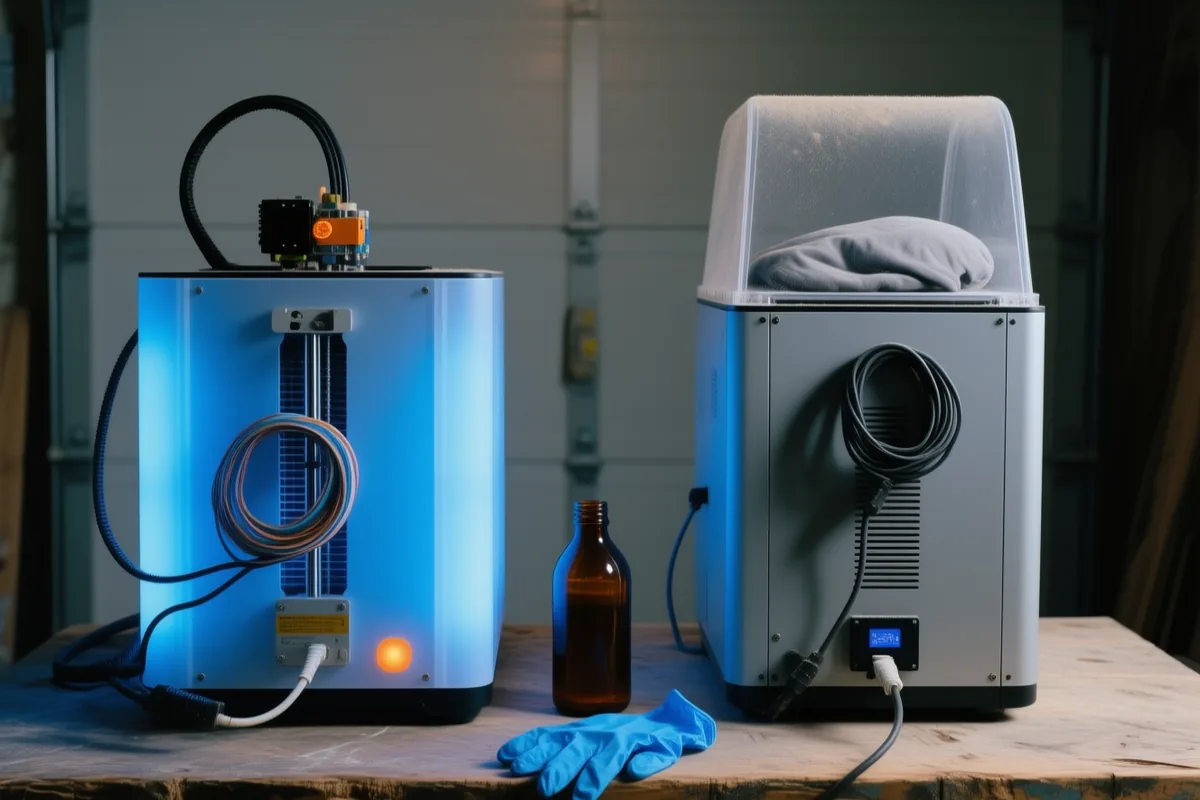
Gleipnir held because of what went into it, not what it looked like. Two machines, two very different answers to the same question.
The short version
Resin prints finer detail. Filament prints in your house.
We own both — a Creality Ender 3 V3 Plus and an ELEGOO Mars 2 Pro with the Mercury wash-and-cure station. Both were bought deliberately. Both work.
Only one of them is switched on.
Why ours is switched off
Asked why the resin printer is not running, the answer was immediate and had nothing to do with print quality: we stopped running ours because the smell is not something we want around a child and pets.
That is the reason most resin-versus-filament comparisons never get to. They compare layer heights and print speeds and surface finish, and they are all correct, and none of it matters if the machine lives in a house with a child and animals in it.
Uncured resin is an irritant and it smells. Every manufacturer tells you to use gloves and ventilation, and they mean it. In a garage or a dedicated room with an extractor, that is a solved problem. In a spare room in a family home, it is a real constraint — and it is the one that actually decides the question for most people.
Our machine is not switched off because it is bad. It is switched off because of where it lives.
The cost, which is not what the sticker says
Here is the other thing comparison articles get wrong. Resin looks like the cheap way in:
| The sticker | What you actually need | |
|---|---|---|
| Resin | Roughly half the price of the filament machine | Plus a wash-and-cure station costing nearly as much again, plus resin |
| Filament | The higher sticker of the two | Plus a spool. That is the entire list. |
By the time both machines are actually printing, the two totals land close enough together that price is not the thing that decides it.
The resin printer is cheaper and the resin setup is not, because the wash-and-cure station is not an accessory — a resin print comes off the build plate wet and has to be washed in alcohol and then UV-cured before it is a solid object. Skip that step and you do not have a cheaper hobby, you have a sticky model.
On our own kit, the verdict was simple: “the printer needs resin, and the Mercury is the post processing. Both work great.” They do. They are also both required.
The speed thing, which most people have backwards
Ask around and you will be told resin is the slow one. On our machines that is not what happens:
“Resin is faster, hands down. I can print a D&D army in 2 hours — 24 minis.”
Twenty-four miniatures in two hours. The reason is not that the machine moves quickly — it is that it does not move at all in the way a filament printer does. A resin printer cures an entire layer in one flash of light, so a plate with twenty-four models on it takes the same time as a plate with one.
A filament printer draws every object with a moving nozzle. Twenty-four miniatures means twenty-four times the drawing, plus the travel between them.
So the honest rule is: resin’s speed advantage is per plate, not per object. For one small thing, the two are comparable. For a batch, resin is not slightly quicker, it is in a different category — which is exactly why it owns the miniatures world.
Worth knowing if you read our piece on dice and minis for a table: buying a bulk box of sixty-four monsters is one answer to filling a table. Printing an army in an afternoon is the other, and it is the reason people put up with the mess.
So which one
Buy resin if you are printing miniatures, busts or anything where surface finish is the whole point, and you have somewhere ventilated to put it that is not shared with kids or pets. Detail is genuinely not close — this is why miniature painters use resin.
Buy filament if you want functional parts, larger objects, or you are printing in a normal room in a normal house. It is coarser. You will see layer lines. It runs in the open air with no post-processing and no gloves.
If you are choosing your first printer and you are not sure, buy filament. It is the more forgiving machine in every way that is not resolution, and it will not end up switched off in a corner.
The honest summary
We are not going to tell you resin is a mistake — we bought one, it works, and for miniatures nothing else comes close. What we can tell you, because it happened here, is that the deciding factor was not print quality or price. It was whether the thing could safely run where we live.
Work that out before you buy, not after.
The picks
ELEGOO Mars 5 resin 3D printer
The current version of the machine we own — ours is a Mars 2 Pro, a couple of generations back. It is the cheaper of the two machines on this page, and it buys detail a filament printer cannot reach, which is why miniature painters use these and not an FDM machine.
- Best for
- Miniatures, busts, and anything where the surface finish is the point.
- Watch out
- This is the printer only. It is not a complete setup and treating it as one is the most common and most expensive mistake in resin printing.
ELEGOO Mercury Plus 2.0 wash and cure station
The other half of the machine, not an accessory. A resin print comes off the plate wet with uncured resin and has to be washed and then UV-cured before it is a finished object. We run this one and it works.
- Best for
- Anybody who buys a resin printer, without exception.
- Watch out
- Budget for it up front. It is roughly half the price of the printer again, and skipping it does not make resin printing cheaper — it makes it not work.
ELEGOO standard 3D printer resin, grey, 1 kg
The consumable. Grey is the sensible default because it shows detail clearly and primes well. 4.7 stars across ten thousand ratings is about as settled as a verdict gets.
- Best for
- General printing, and anything you intend to paint.
- Watch out
- Uncured resin is an irritant. Gloves are not optional, and neither is ventilation — see below, because this is the part that decides whether you can run one at all.
Creality Ender 3 V3 Plus filament printer
The other machine on this team, and the one that is actually still running. Filament is coarser than resin, but it prints in the open air, in a room with people in it, with no post-processing beyond snapping off supports.
- Best for
- Functional parts, larger objects, and anyone who cannot dedicate a ventilated space.
- Watch out
- You will see layer lines. That is the trade, and for most things it does not matter.
Overture High Speed PLA filament, 1.75mm, 1 kg
The standing rebuy on the filament side. Consistent diameter and neatly wound spools are what decide whether a nine-hour print finishes.
- Best for
- Everyday filament printing.
- Watch out
- PLA absorbs moisture from the air. Bag it with desiccant between jobs.
We do not list prices; they change daily. The button opens the current Amazon page.